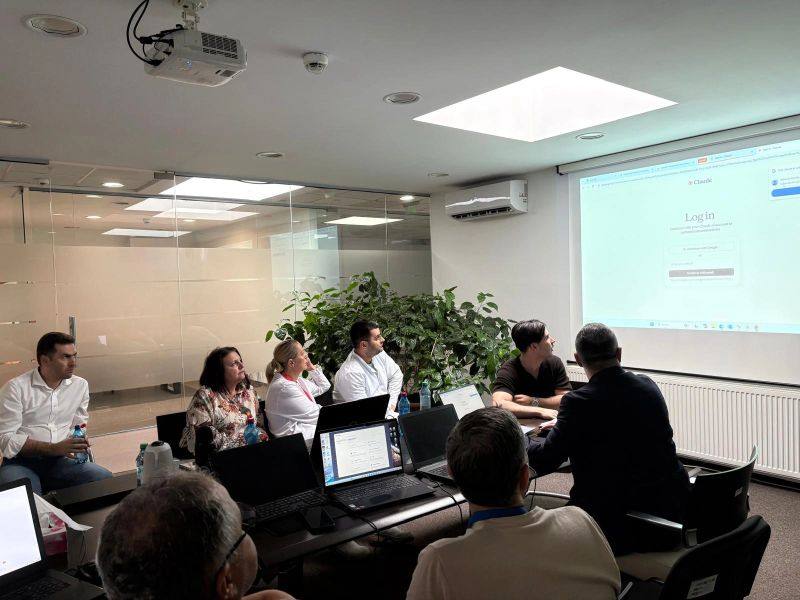
Small groups, not a packed room
Small groups (around 14 people) allow at least half the time to be real hands-on practice, not just slides. In a production program with 28 employees, we worked with two separate groups — both for the quality of the practice, and because you can't pull everyone off the line at once.
The standard program: day 1 = AI fundamentals + prompt engineering; day 2 = Claude Code, Skills, MCP and connecting to everyday tools (Excel, PowerPoint, Chrome). An AI workshop for teams works well in small groups of around 14 people, where everyone gets real practice time, not just slides to watch.
Mental models, not prompt tricks
The curriculum is built on Andrej Karpathy's mental models — the context window as RAM, the LLM as an operating system, "Software 3.0" — because prompt tricks age fast, but the underlying understanding stays useful no matter what model comes out next year.
The exercises are role-relevant: someone from procurement practices on a procurement case, not on a generic „write an email” example. The curriculum also includes Agent Skills — structured instruction packages that an AI assistant loads for a specific task — which have already become a standard used by several AI tools, not just one. The EU AI Act module in the curriculum covers exactly what AI Act transparency obligations apply to small businesses, with the real 2026 enforcement deadlines.
What training level fits your team?
Pick the card that describes your team. The quote request goes out with the tier pre-filled.
A team with no AI experience
Fundamentals: how a model works, prompt engineering, context and memory. Ideal as a first introduction.
Request a quote · FundamentalsA team that already uses ChatGPT / Claude occasionally
Claude Code, Skills, MCP, connecting to Excel, PowerPoint and Chrome. From passive use to active building.
Request a quote · AdvancedA technical team or management that wants governance
EU AI Act module: data classification, real risks, internal usage policy.
Request a quote · EU AI ActWhat can and can't go to the AI
Any serious corporate training starts with a clear classification of data: what's allowed, what's allowed with conditions, what's strictly forbidden (sensitive personal data, credentials, information under NDA). We teach the company's internal policy as a day-1 module, not a footnote.
In one real case, that meant building the client’s own internal Claude usage policy directly into the course material, with concrete examples of „what to do” and „what not to do”. Every corporate AI training, including the Claude Code corporate training modules, starts with a clear classification of what data is allowed to reach conversations with the model. For teams that go on to configure their own AI assistants after training, we explain separately what an Agent Skill is, in short, and how to check it before installing it.

Governance is no longer optional
From 2026, AI literacy obligations for employees become part of the legal compliance of companies using AI systems, not just a good practice. A dedicated module covers risk classification, obligations for SMEs, and the difference between using and providing AI systems.
For leadership teams, this module is taught separately, with a focus on responsibility and decision-making, not daily use. A dedicated EU AI Act training module is part of every program, because AI literacy obligations for employees are becoming part of legal compliance, not just good practice. The format described above is the one actually used at the two groups at FOX, with the full program documented in the case study.
From use to building
After the fundamentals, teams who want more move on to an advanced track: custom connectors/MCP, automated recurring tasks, a capstone project on a real case from the company. This level isn't sold on day one — it's discussed once the team has been through the fundamentals and knows what it wants to build.
It is the difference between „employees know how to write a good prompt” and „the company has its own automations built in-house”. Advanced-level employee AI training also includes the governance side — what permissions an agent gets, not just how to write a good prompt. Training is often the first step of an AI implementation plan for the company.
From program to classroom, no improvisation
Every program starts with a scoping discussion, not a fixed curriculum imposed from the start.
- 01Scoping conversation: the team's starting level, roles, existing internal policy
- 02We build the curriculum around the real roles in your company, with dedicated exercises
- 03We deliver in small groups, at least 50% hands-on practice
- 04We hand over materials + a certificate of participation + a recommendation for the next step
A fixed price, after a short discovery call.
- 2 days x 2 groups
- at least 50% hands-on practice
- materials + certificate of participation
- data classification (allowed/conditional/forbidden)
- real risks, not theory
- internal usage policy
- custom skills
- connectors/MCP
- a capstone on a real case
Every project has a different context, workflows and infrastructure, so the price is set after a short, paid discovery and does not change along the way.
Frequently asked questions
How much does AI training for employees cost?
Additional modules (EU AI Act, an advanced track) are quoted separately, depending on content.
What does an AI course for companies teach?
The fundamentals of how an AI model works, prompt engineering, context and memory, then the applied part: Claude Code, Skills, MCP and connecting to everyday tools (Excel, PowerPoint, Chrome). Security and data classification modules are built in, not optional.
What is the EU AI Act, and how does it affect internal training?
The EU AI Act is the European regulation that classifies AI systems by risk and imposes, among other things, AI literacy obligations for employees who use such systems. In practice, corporate training should include a dedicated module on these obligations, not just technical usage.
How long does AI training for a team take?
A standard base program runs two days per group (fundamentals + applied practice). For large teams, it's organized into smaller groups delivered sequentially — for example, 28 people in two groups of 14, four days of delivery in total.
Is AI training suitable for employees with no technical experience too?
Yes — the base program is built explicitly for non-technical staff, with at least half the time as guided practice. In one real case, some participants didn't even have their own laptop, and the sessions were adapted with shared laptops and live demos.
What's the difference between basic AI training and the advanced track?
The basic level teaches the team to use existing AI well (prompting, context, standard tools). The advanced track moves into building: custom connectors, recurring automations, a real project taken all the way through — and it's only discussed once the team has been through the fundamentals.
Who runs the training — an external trainer or the in-house team?
We recommend an external trainer for the first round, because they bring experience from multiple real implementations, not just theory. The materials and curriculum structure stay with the company, though, for later in-house runs.
What concrete AI Act transparency obligation already applies to companies in Romania?
Article 50 of the AI Act, in force since 2 August 2026: any automated conversational system must identify itself as such, and synthetic content generated with AI must be labeled, regardless of company size. For content published before that date, the grace period for retroactive labeling is 2 December 2026.
Is there also an AI course for accounting or for automation?
The training exercises are built on each team's real workflows. For accounting that means invoices, bank statements and checks before SAF-T, and for operations, automations between the systems used every day.

Let's see what can be automated in your business.
A free 30-minute session: we'll tell you what can be automated, how long it takes and what it costs, with a fixed price after discovery.