
From internal portal to a product with paying clients
A good web app isn't just a pretty frontend over a form. It means secure authentication, correct role-based permissions, and a database structured to handle volume.
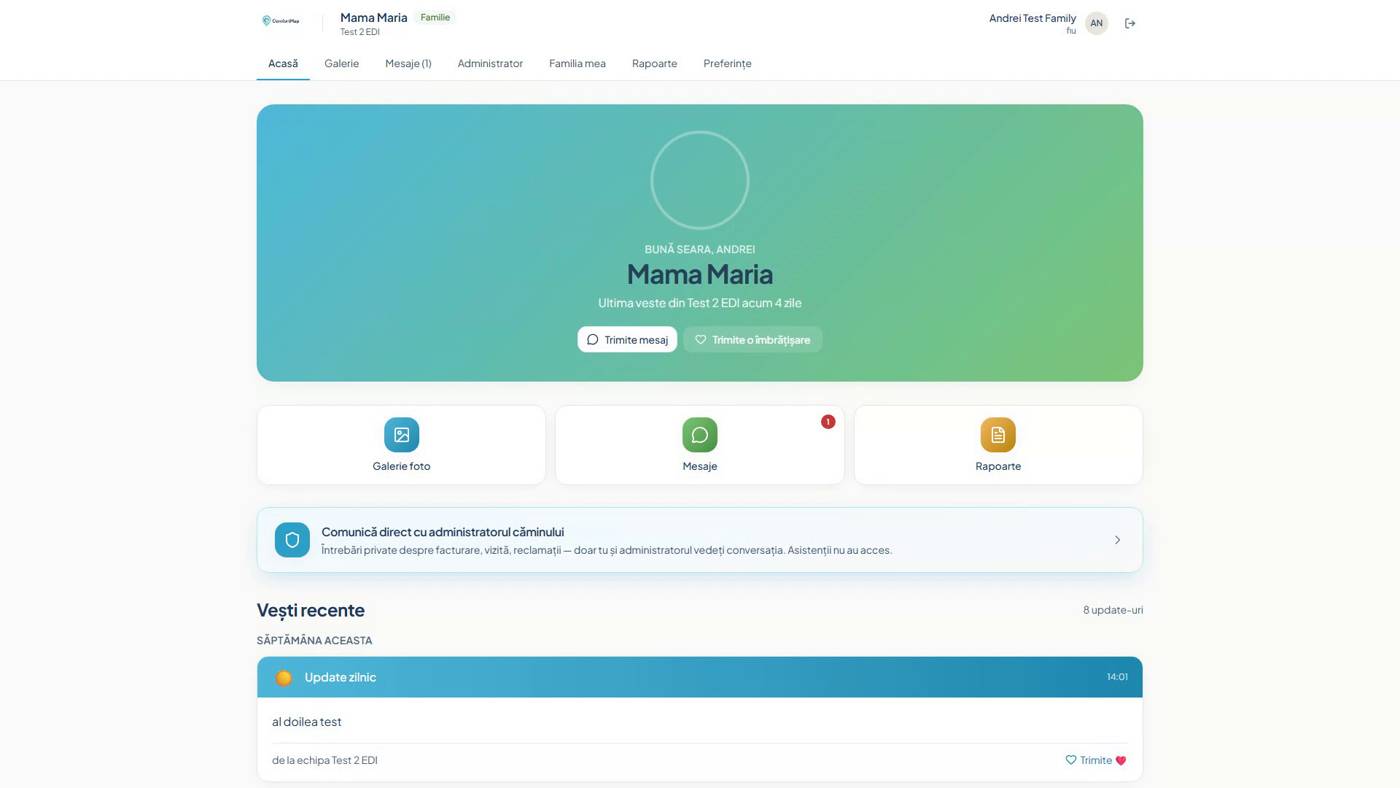
We built, for example, a portal for care homes with three access types (staff, family, super-admin), each with its own dashboard and permissions isolated through RLS (Row Level Security) in the database. A custom web app differs from a regular website through authentication, role-based permissions, and a database structured to hold up under real volume.
Magic link, no passwords to manage
Secure sessions, granular roles, per-tenant data isolation.
Panels for the team, not just for clients
Import data, statuses, reports — the tools the team uses daily.
Fast rendering, indexable by Google
ISR (Incremental Static Regeneration) for public pages that need to be both fast and found on Google.
Why what's built behind the scenes matters
A properly built platform clearly separates operational (sensitive) data from public data, uses an audit log for critical actions, and handles every error with a dedicated boundary — not a blank white screen. A second example: a platform recloned for 14 brands shows how the same base architecture can support multiple isolated instances, without unnecessary duplicated code. a second example: a platform recloned for 14 brands.
- 01Tenant data isolation each client sees only what's theirs, enforced at the database level, not just in the interface.
- 02Audit log for sensitive actions who did what and when, kept as required by law.
- 03Dedicated error boundaries an error in one module doesn't take down the whole product — the user sees a clear message, not a crash.
Fast MVP vs. scalable platform
Click a row for details.
| Low-code MVP | Custom app | |
|---|---|---|
| Time to launch+ | fast | medium |
| A low-code MVP can be ready in days; a custom app needs weeks, but it starts with the architecture already in place. | ||
| Initial cost+ | small | medium to large |
| Low-code costs little at the start, but subscription prices grow with users and features. | ||
| What it costs as you grow+ | expensive, a full rewrite | predictable, architecture ready |
| The most common story: the MVP works, then it has to be rewritten from scratch once paying customers show up. | ||
| Data ownership+ | often to the third-party platform | 100% yours |
| With low-code, data export is sometimes limited or paid. With custom, the database is yours. | ||
| Custom integrations+ | limited to what the platform offers | unlimited |
| Integrations with ERP, couriers, e-Factura, or API-less systems need custom code. | ||
| Who it's a fit for+ | quick idea validation | a product with real paying customers |
| If you don't yet know whether the idea takes off, validate it with low-code. If you have customers, build it properly. | ||
A production bug, found and fixed
In an audit on a live platform, we found the real cause of intermittent errors: a session update was failing silently because of an overly strict security policy, which left some users without access to their own account, with no visible error message.
We fixed the cause (not just the symptom), added error boundaries across every area of the app, and replaced leftover mock data from development with real data, verified live across all three roles. ComfortMap, with separate roles for the public directory, care-home staff and families, shows concretely how a custom web app handles very different users in the same system, without mixing up permissions. For platforms that integrate AI directly into the product, we explain separately how we avoid depending on a single model provider, so the app never stays locked into a single option.
When a custom app is worth it, not a no-code tool
A no-code tool (Airtable, Bubble) is enough as long as the process is simple and volume is low. When you need complex roles, multiple integrations, or plan to sell access as a product, a custom platform becomes cheaper in the medium term. SaaS development in Romania means, for us, exactly this kind of platform with paying customers — not a generic cloned product, but a custom SaaS platform built around your workflow.
From discovery to a live platform
We map roles and workflows before architecture, build in verifiable stages, and deliver with complete admin documentation.
A fixed price, after a short discovery call.
- authentication included
- 1 basic integration
- 4-6 weeks
- RLS on data
- audit log
- 6-10 weeks
- payment processor
- invoicing + e-Factura
- launch support
Every project has a different context, workflows and infrastructure, so the price is set after a short, paid discovery and does not change along the way.
Frequently asked questions
What's the difference between a custom web app and a regular website?
A website presents information. A web app has user accounts, stores and processes data, and usually has different roles (admin vs. client). The technical complexity is far greater. Source: editorial
How much does a SaaS platform cost?
It varies enormously with the number of roles and integrations. We give a fixed price after discovery — see /preturi for indicative benchmarks from real projects. Source: editorial
What technologies do you use?
Next.js/React + TypeScript on the frontend, Supabase/Postgres on the backend for most projects — mainstream technologies, easy for any future technical team to maintain. Source: editorial
Can you take over an existing platform that has issues?
Yes — we do a technical audit, identify the real cause of the problems (not just the symptoms), and fix or re-architect the affected areas. Source: editorial
How do you guarantee data security between different clients?
Through isolation at the database level (Row Level Security), not just at the interface level — a user can't access another tenant's data even through a manually modified URL. Source: editorial
What happens to my data if I stop the collaboration?
They stay entirely yours — they're in a database you own, not in an account of ours that we shut down. Source: editorial
Does a custom SaaS platform always start from zero, or can code be reused from an earlier project?
It depends on how similar the workflow is. For Consumer Voice, we built the engine once and recloned it for 14 different brands, clearly separating what is „engine” from what is „identity” — but every new project still starts with its own discovery, not with the assumption that it will simply fit.
Which custom web platforms make sense for a company?
The ones that cover a process off-the-shelf tools don't handle well: client or partner portals, internal admin panels, multi-client SaaS platforms and integrations between existing systems. For most of them we build on Next.js and Supabase/Postgres, mainstream technologies any team can take over.
What does a scalable web application actually mean?
One that can take more users, more data and new clients without being rewritten: each client's data isolated at database level, critical actions kept in a log, errors handled without bringing the whole system down, and an architecture that clearly separates sensitive data from public data.

Let's see what can be automated in your business.
A free 30-minute session: we'll tell you what can be automated, how long it takes and what it costs, with a fixed price after discovery.